
THE NEED FOR INFORMED CONSENT REFORM
The ICF was originally designed to help protect research participants, but many of the modern issues and concerns healthy volunteers experience today are still not clearly addressed within current Informed Consent materials.
As clinical research continues to evolve, HVA believes the ICF must also evolve to provide greater transparency, communication, participant protections, and clearer understanding regarding the real-world issues participants may face throughout the research process.
Continue reading below to learn more about HVA’s proposed clinical research reforms.

Keep Scrolling
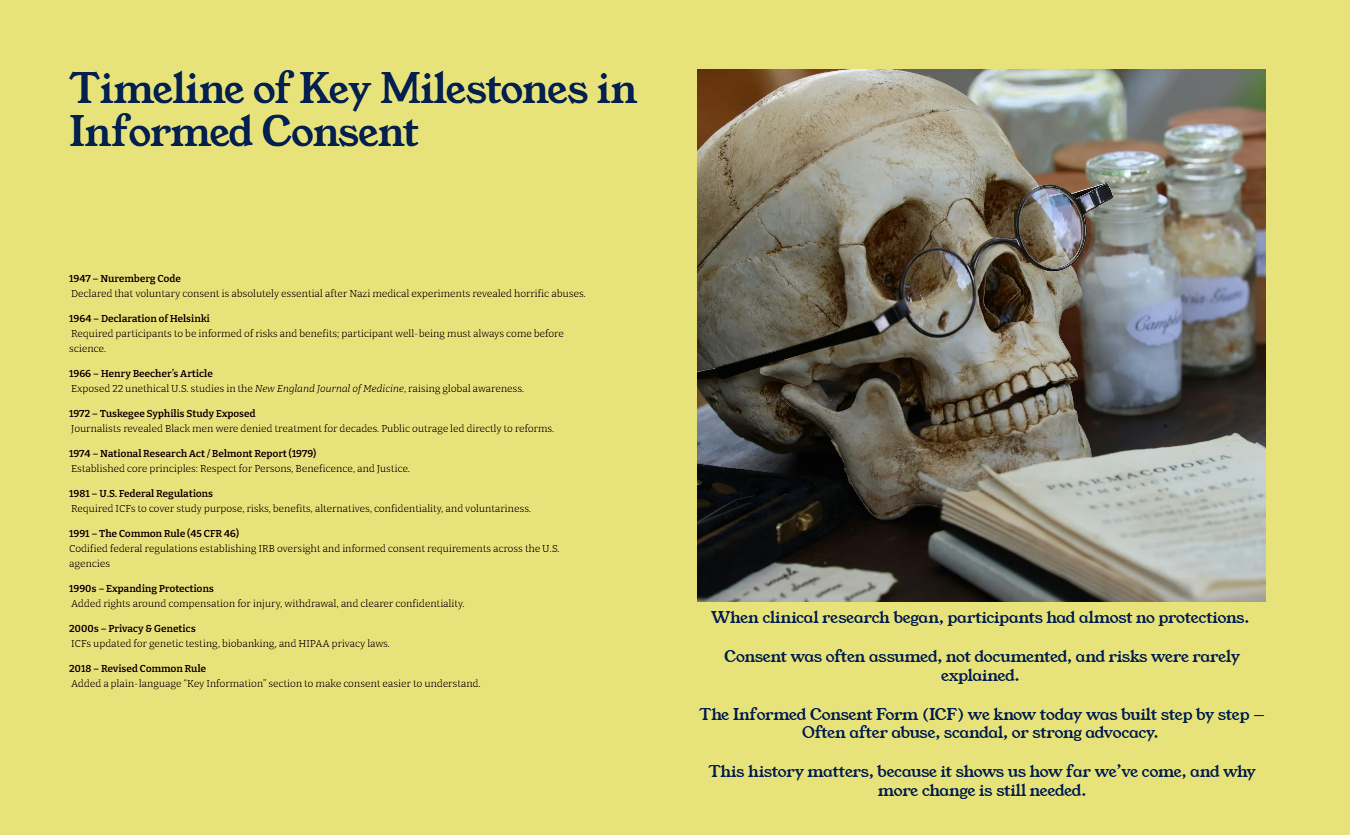
Click the Timeline image below to explore the full History of Informed Consent.
Keep Scrolling
HVA welcomes participant feedback, comments, and additional recommendations regarding informed consent, participant protections, and clinical research reform efforts.
If there are concerns, experiences, or participant protections you believe are not already addressed here and should be considered within future informed consent practices, we encourage you to share your feedback and suggestions with us through our Contact Page.
Your voice and experiences matter!
Healthy Volunteers Alliance (HVA)
Participant Advocacy and Clinical Research Reform Priorities
The Healthy Volunteers Alliance (HVA) believes healthy volunteers play a critical role within clinical research and deserve greater transparency, consistency, communication, and participant protections throughout the research process.
The following priorities summarize key areas in which HVA believes clinical research practices, informed consent standards, participant protections, and regulatory oversight may benefit from modernization, clarification, and greater accountability in order to strengthen participant understanding, fairness, trust, and overall research integrity.
1. Greater Transparency Regarding Inclusion and Exclusion Practices
HVA believes participants deserve clearer explanations regarding why certain demographic groups are excluded from particular studies, including exclusions involving age, sex, gender identity, reproductive or childbearing status, nationality, and other participant characteristics.
Many healthy volunteers report frustration and confusion regarding inconsistent eligibility decisions, unexplained demographic restrictions, and the lack of meaningful explanations regarding why certain groups may or may not qualify for participation.
Current clinical research practices often allow significant variation in how research sites and sponsors interpret and apply exclusion criteria, resulting in inconsistent participant experiences and limited transparency regarding how eligibility decisions are being made.
HVA believes participants should have access to clearer participant-facing explanations regarding significant eligibility restrictions and the scientific, medical, or safety rationale underlying those decisions so participants can better understand what standards research organizations are expected to follow and why particular demographic exclusions may apply.
HVA believes greater transparency regarding demographic eligibility practices and exclusion criteria should be more clearly incorporated into informed consent materials so participants can make more informed decisions before agreeing to participate in clinical research.
2. Greater Transparency Regarding Participant Tracking Systems and Screening Restrictions
HVA believes participant tracking systems used within clinical research should be subject to greater oversight, accountability, transparency, consistency, and participant protections.
Many healthy volunteers are asked to trust systems that collect, store, and share sensitive screening and participation-related information without fully understanding what information is being collected, how long it may be retained, whether it may be shared across organizations, how it may affect future eligibility decisions, or what protections exist when inaccurate information or other concerns arise.
Participants should receive clear information regarding whether a participant tracking system is being used, the specific tracking system being utilized, what information may be collected, how that information may be used, how long it may be retained, whether information may be shared between organizations, and whether screening-only activity may be entered into the system even when no investigational product is administered.
HVA believes participants should also receive clearer information regarding screening restrictions, dual-screening policies, delayed status updates, alternate waiting periods, exclusivity practices, and whether these policies may affect future participation opportunities or temporarily prevent them from pursuing other studies.
When participant tracking systems, screening restrictions, or related clinic policies limit a participant's ability to pursue other research opportunities during screening, admission, alternate waiting periods, or other study-related processes, participants should receive clear disclosure regarding those limitations and appropriate compensation for the time, travel, scheduling restrictions, lost income, and participation opportunities associated with those expectations.
Participants should have meaningful opportunities to request clarification, review records, obtain additional information, challenge inaccurate information, request corrections, and seek timely resolution when tracking system records may affect eligibility decisions or future participation opportunities. Participants should also have access to clear reporting pathways when concerns involve participant tracking practices, information sharing, screening restrictions, delayed status updates, inaccurate information, or administrative consequences associated with screening activity.
HVA believes the FDA should establish clearer oversight expectations, accountability standards, auditing requirements, participant reporting pathways, review mechanisms, and independent oversight structures applicable to participant tracking systems utilized within clinical research. Participants should not be expected to rely solely on private organizations to oversee systems that may significantly influence eligibility decisions, participation opportunities, and long-term handling of participant information.
HVA also believes the informed consent process should clearly disclose whether a participant tracking system is used, identify the specific tracking system being utilized, explain what information may be collected, retained, shared, or reported, describe how tracking system records may affect future eligibility decisions, and provide participants with information regarding how to obtain additional information, request clarification, report concerns, review records, or seek correction of inaccurate information. When separate tracking system consent or authorization forms are required, participants should be informed of their purpose and provided access to copies of any documents they are asked to sign.
By incorporating participant tracking system disclosures, participant protections, reporting pathways, screening restrictions, compensation policies, and oversight expectations into informed consent materials, participants will be better equipped to make informed decisions before agreeing to screening or study participation. Greater transparency, accountability, and oversight would improve participant understanding, reduce confusion regarding screening restrictions and administrative consequences, strengthen trust within the clinical research system, and help support greater consistency, fairness, and integrity across research organizations.
3. Modernized Drug Screening Standards and Participant Protections
HVA believes clinical research drug screening practices and participant protections should be modernized to better reflect the growing number of legally available medications, supplements, food products, and other substances now known to affect certain preliminary drug screening results.
Many healthy volunteers report being excluded, flagged, restricted from future participation, or denied further review based on preliminary drug screening results that may later prove inaccurate, unconfirmed, or influenced by legally available products, unintended exposure, or medically documented prescriptions.
Participants should receive clearer information regarding the types of drug screening methods being used, the limitations of preliminary testing, whether confirmatory testing is available, and whether positive or unconfirmed results may affect future eligibility or participation opportunities.
HVA believes participants should have meaningful opportunities to request clarification, review, and when appropriate confirmatory testing before significant exclusion decisions or long-term participation restrictions are imposed based only on preliminary or unconfirmed screening results.
HVA also believes drug screening practices, participant protections, confirmatory testing options, reporting pathways, and possible administrative consequences associated with screening results should be more clearly incorporated into informed consent materials so participants can make more informed decisions before agreeing to participate in clinical research.
4. Greater Transparency and Fairness Regarding Participant Compensation Protections
HVA believes participants should receive clearer information regarding compensation policies involving study cancellation, delayed admission decisions, extended waiting periods, participant dismissal, early release from participation, or other situations that may affect expected compensation.
Many healthy volunteers spend significant time and money preparing for clinical research participation, including travel, transportation arrangements, scheduling restrictions, unpaid time away from work, required screening appointments, and study-related preparation requirements before ever being officially admitted into a study.
Participants should not be left uncertain regarding what compensation will or will not be provided when studies are canceled, delayed, overenrolled, postponed, or when participation is interrupted or ended for reasons outside the participant’s control.
HVA also believes participants should receive clearer disclosure regarding whether compensation will be partial, prorated, or fully provided under different study-related circumstances so participants can make more informed decisions before agreeing to participate.
HVA also believes compensation protections are important to both participant safety and study integrity. Participants should not feel pressured to hide symptoms, adverse events, side effects, or safety concerns out of fear that reporting those issues may result in dismissal from participation and loss of expected full study compensation. When participation is ended for medical, safety, administrative, or study-related reasons outside the participant’s control, participants should receive full or appropriately protected compensation so that financial concerns do not discourage honest safety reporting during clinical research participation.
HVA believes these compensation policies, participant protections, financial expectations, and circumstances affecting compensation eligibility should be more clearly incorporated into informed consent materials so participants can make more informed decisions before agreeing to participate in clinical research and feel more secure reporting adverse events, symptoms, side effects, or safety concerns without fear of losing expected compensation, therefore helping maintain the integrity of the study itself.
5. Clearer Site-Level Administrative Review and Participant Resolution Processes
HVA believes participants should have access to clearly identified site-level participant-support and administrative review pathways that serve as a first level of participant support before outside escalation becomes necessary. Currently, most participants are limited to recruiting phone numbers, general online forms, or recruitment contacts that are often unable to address concerns beyond basic recruiting or scheduling matters, and to HVA’s knowledge, few if any clearly defined site-level participant-support pathways currently exist across many clinical research organizations.
Participants should have access to designated site-level participant-support contacts who can help address communication problems, unexplained exclusions, inaccurate participant information, payment concerns, scheduling conflicts, recruitment misunderstandings, unfair bans or participation restrictions, and other participant-related issues that directly affect their ability to participate in clinical research.
HVA believes these site-level participant-support and administrative review pathways should be disclosed within informed consent materials so participants understand who they can contact when concerns arise and so that consistent participant-support pathways exist across clinical research organizations rather than varying from site to site. This information should include clearly identified contact methods such as phone numbers, email addresses, reporting forms, website reporting pathways, or other accessible participant-support resources so participants have this information readily available when concerns occur.
6. Independent Participant Advocacy and Support Pathways
HVA believes participants should have access to independent participant advocacy and support organizations or oversight resources capable of helping participants navigate concerns, reporting guidance, confidentiality questions, communication concerns, administrative disputes, requests for review or correction of inaccurate information, and broader participant-protection concerns throughout the clinical research process.
Many healthy volunteers report uncertainty regarding where concerns should be directed, what protections are available, or who is responsible for addressing participant concerns that may arise throughout the clinical research process.
HVA believes these independent participant advocacy and support pathways should serve as a secondary level of participant support when site-level administrative review pathways have been exhausted, failed to resolve concerns, or when participants do not feel comfortable addressing concerns directly through research sites or recruiting departments.
Participants should have access to confidential and anonymous reporting options, participant-support resources, and independent advocacy pathways without fear of retaliation, exclusion, or loss of future participation opportunities for reporting concerns.
HVA believes the FDA should establish clearer standards and oversight expectations regarding independent participant advocacy and support resources separate from recruitment departments, sponsors, and research sites.
HVA believes the FDA should require clearly identified independent participant advocacy and support resources to be disclosed within informed consent materials, including appropriate contact information, reporting options, confidentiality protections, and explanations regarding the types of participant concerns these pathways are intended to address.
HVA believes clearer establishment and disclosure of independent participant advocacy and support resources would improve participant understanding, strengthen transparency and accountability, help reduce fear of retaliation for reporting concerns, and support greater trust and integrity within the clinical research system, ultimately helping create a stronger, safer, and more accountable clinical research environment for participants, research organizations, sponsors, and oversight bodies alike.
7. Clearer IRB Role, Reporting, and Confidentiality Disclosures
HVA believes participants should receive clearer disclosure regarding the role of Institutional Review Boards (IRBs), including what types of concerns IRBs handle, what issues may fall outside their scope, how participant confidentiality is managed when concerns are reported, and the need for anonymous reporting pathways to be made available to participants.
Many informed consent materials currently provide only the name of the IRB and basic contact information without clearly explaining the IRB’s role, reporting process, confidentiality protections, or limitations within the clinical research system.
Many healthy volunteers report confusion regarding what IRBs actually handle, what participant protections exist when concerns are reported, and whether reporting concerns could negatively affect future participation opportunities. Participants frequently express fear of retaliation, exclusion, or unfair bans for reporting concerns, especially because IRBs are often viewed as closely connected to the sponsors and research organizations they oversee rather than as fully independent participant advocacy resources.
HVA believes participants would benefit from clearer understanding regarding the role and limitations of IRBs within clinical research oversight. Because many participant concerns involving administrative disputes, communication failures, unfair bans or participation restrictions, compensation issues, and other non-safety-related concerns often fall outside the practical scope of traditional IRB review processes, this further demonstrates why separate site-level participant-support pathways and independent participant advocacy resources are needed.
HVA believes clearer IRB disclosures, confidentiality protections, reporting pathways, and anonymous reporting options should be incorporated into informed consent materials so participants can make more informed decisions regarding when and how IRB reporting processes should be utilized.
HVA believes greater transparency regarding IRB reporting practices and participant protections would improve participant understanding, reduce confusion regarding reporting pathways, strengthen accountability within clinical research oversight systems, and help support greater trust, integrity, and confidence throughout the clinical research process.
Conclusion
Many of the concerns healthy volunteers continue to experience throughout clinical research stem from a lack of transparency, communication, participant understanding, and clearly defined participant-support pathways.
While the Revised Common Rule introduced important informed consent updates in 2018, many of the operational, administrative, transparency, communication, and participant-protection concerns experienced by healthy volunteers today still remain largely absent from current informed consent practices.
Many existing informed consent standards were developed before the widespread use of participant tracking systems, modern screening exclusivity practices, large-scale administrative data sharing, and many of the participant-access and communication issues now commonly reported throughout early-phase clinical research.
By modernizing and expanding informed consent materials to more clearly address participant concerns involving eligibility practices, participant tracking systems, drug screening practices, compensation policies, reporting options, participant protections, and available support resources, many of these long-standing issues could be significantly reduced or prevented altogether.
The informed consent process was designed to help protect research participants by ensuring they have access to clear and meaningful information before agreeing to participate in clinical research. Participants should not be expected to navigate important medical, administrative, financial, and participation-related decisions without fully understanding how eligibility practices, participant tracking systems, drug screening practices, compensation policies, site-level support options, independent advocacy resources, IRB reporting pathways, and other participant protections may affect them both during and after study participation.
Improving transparency, communication, participant protections, and informed consent practices would not only benefit healthy volunteers, but would also strengthen fairness, accountability, consistency, trust, and the overall integrity of the clinical research system for all parties involved.